Write Your Skill
A skill is simply a text file called SKILL.md. It has two parts: a short header at the top that tells Claude what the skill is for and when to use it, and your instructions underneath, written in everyday language.
You’ll write yours by filling in a template. First, let’s open somewhere to write it.
Open a plain-text editor
A plain-text editor saves only the words you type. Word processors like Word or Pages add hidden formatting that Claude can’t read, so they won’t work for this.
- Open TextEdit (it’s in your Applications folder, or you can search for it with Spotlight).
- Start a new document.
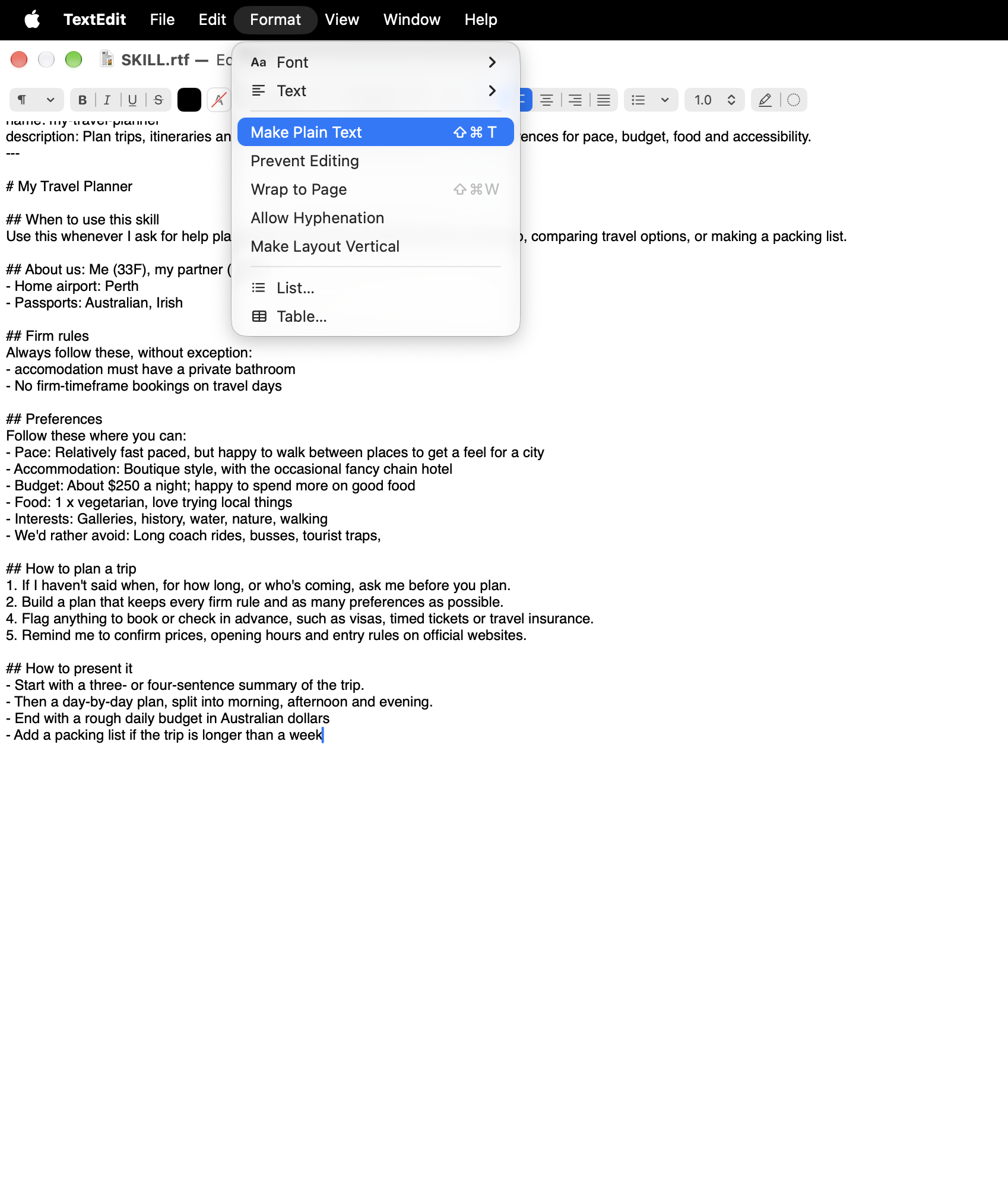
- From the menu bar, choose Format > Make Plain Text.
Step 3 is important. TextEdit normally saves in “rich text”, which won’t work for a skill.
- Open Notepad (search for it from the Start menu).
- Start a new document.
Notepad already saves plain text, so there’s nothing else to change.
- Open your plain-text editor app, such as Runestone.
- If your facilitator gave you a starter folder called
my-travel-planner, save it to the Files app, then open theSKILL.mdfile inside it. The template is already there, so you can skip ahead to Fill it in. - Otherwise, create a new file.
The Notes and Pages apps save in their own formats, so they won’t work here.
If typing on screen is tricky, tap the microphone key on the keyboard and speak your answers instead.
Copy the template
Copy everything in the box below and paste it into your editor. The Copy button in the corner of the box copies it all in one click.
---
name: my-travel-planner
description: Plan trips, itineraries and packing lists using my personal travel preferences for pace, budget, food and accessibility.
---

# My Travel Planner

## When to use this skill
Use this whenever I ask for help planning a trip, holiday, weekend away or day trip, comparing travel options, or making a packing list.

## About us
- Who travels: [e.g. me and my husband, both in our late 60s]
- Home airport: [e.g. Perth]
- Passports: [e.g. Australian]

## Firm rules
Always follow these, without exception:
- [e.g. No more than two activities a day, with a rest after lunch]
- [e.g. Nothing starting before 9am]
- [e.g. Accommodation must have a lift]

## Preferences
Follow these where you can:
- Pace: [e.g. slow; we like to linger rather than tick things off]
- Accommodation: [e.g. small hotels in a central, quiet street]
- Budget: [e.g. about $250 a night; happy to spend more on good food]
- Food: [e.g. no shellfish; love local markets]
- Interests: [e.g. gardens, galleries, history]
- We'd rather avoid: [e.g. crowds, long coach tours, tourist-trap restaurants]

## How to plan a trip
1. If I haven't said when, for how long, or who's coming, ask me before you plan.
2. Build a plan that keeps every firm rule and as many preferences as possible.
3. For each day, note walking distances, hills and stairs.
4. Flag anything to book or check in advance, such as visas, timed tickets or travel insurance.
5. Remind me to confirm prices, opening hours and entry rules on official websites.

## How to present it
- Start with a three- or four-sentence summary of the trip.
- Then a day-by-day plan, split into morning, afternoon and evening.
- [e.g. End with a rough daily budget in Australian dollars]
- [e.g. Add a packing list if the trip is longer than a week]
Fill it in
Now make it your own, using the notes from the last page.
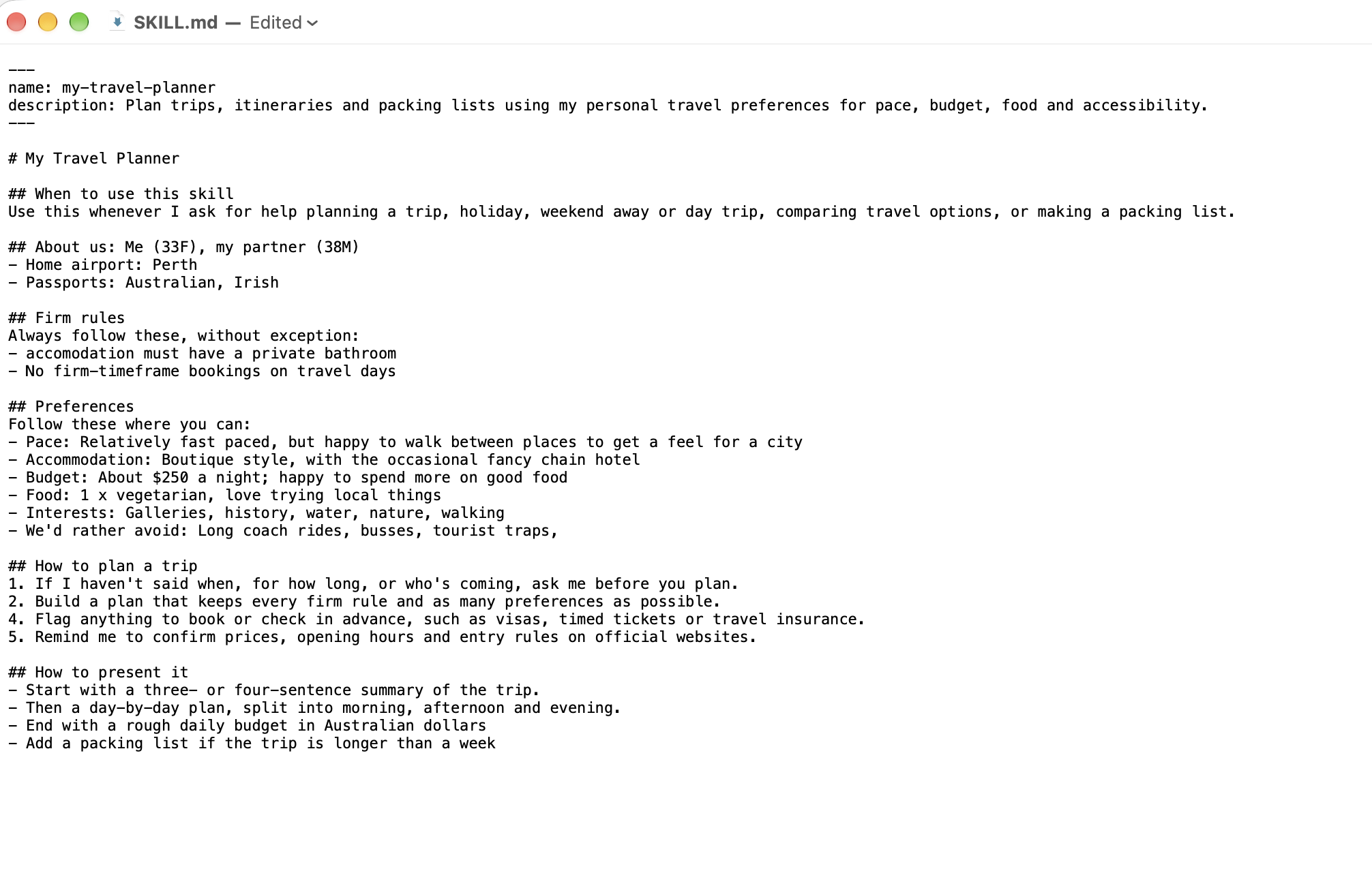
- Replace each part in [square brackets] with your own answer, and delete the brackets and the “e.g.”.
- Delete any lines that don’t apply to you.
- Add lines for anything we haven’t covered.
- Leave the header (the lines between the two
---at the top) as it is for now.
What does each part do?
The header is the only part Claude reads at first. It’s like the label on a folder: Claude reads it to decide whether to open the folder and read the rest.
nameis your skill’s short name. Use lowercase letters and hyphens only, with no spaces (up to 64 characters). Keeping it asmy-travel-planneris the simplest option.descriptionis the most important line in the file. It tells Claude what the skill does and when to use it. Mentioning trips, itineraries and packing lists helps Claude know to use it whenever travel comes up. Keep it under 200 characters.
When to use this skill gives Claude a fuller picture of the requests this skill is for.
About us is the background a good travel agent would ask about first.
Firm rules are the things you won’t compromise on. Words like “always”, “never” and “no more than” work well here, because Claude follows clear rules more reliably than gentle hints.
Preferences are your nice-to-haves. Claude aims for them, but can make trade-offs when it needs to. The more specific you are, the better: “about $250 a night” is more helpful than “mid-range”.
How to plan a trip is the method you’d like Claude to follow. The first step asks Claude to check with you when something’s missing, rather than guessing.
How to present it describes what the finished answer should look like.
A few writing tips
- Write as if you’re briefing a capable assistant who has never met you. If a stranger could follow it, Claude can too.
- Keep this skill about travel. If you’d like Claude’s help with something else later, you can make a separate skill for it.
Keep your editor open. On the next page, you’ll save your file in the right place.
Want to read more?
- How to create custom skills (Claude Help Center)